
Ever wondered how to describe someone acting without sense or wisdom? A metaphor for a fool can transform ordinary speech into something colorful, memorable, and even humorous. 🌟
In this guide, we’ll explore vivid metaphors, their origins, examples, and how you can use them in everyday conversations or writing. Get ready to unlock the secrets of expressive language that conveys folly with flair!
What Is a Metaphor for a Fool? 🤔
A metaphor for a fool is a figurative expression that describes someone who behaves ignorantly, carelessly, or without insight. Instead of saying, “He is foolish,” metaphors add imagery, emotion, and humor to the idea.
- Example: Saying “He’s a sitting duck” paints a vivid picture of vulnerability, suggesting someone is foolishly exposed to harm.
- Why it works: Metaphors connect abstract ideas (foolishness) with concrete visuals, making the language memorable.
Origins of Fool Metaphors 📜
Throughout history, writers, poets, and philosophers have used metaphors to describe folly. From Shakespeare’s jesters to proverbs in ancient texts, calling someone a fool often carried both humor and moral lessons.
“Better a witty fool than a foolish wit.” – Shakespeare
Common Metaphors for a Fool
Here’s a curated list of powerful and widely recognized metaphors:
| Metaphor | Meaning | Example |
|---|---|---|
| Sitting Duck 🦆 | Someone vulnerable due to foolishness | “Without checking the road, he ran—what a sitting duck!” |
| Clown 🤡 | Acts foolishly, seeks attention | “He spilled coffee everywhere—total clown moment.” |
| Loose Cannon 💥 | Unpredictable, reckless | “That employee is a loose cannon, watch out!” |
| Birdbrain 🐦 | Someone not very smart | “Don’t expect him to plan—he’s a birdbrain.” |
| Fool’s Gold 🪙 | Appears valuable but isn’t | “His promises were fool’s gold; nothing real.” |
Creative Literary Metaphors for Fools ✍️
Writers often use metaphors to deepen characterization. Here are examples from literature:
- Jester or Fool: Symbolizes someone witty yet underestimated.
- Pawn in a Game: Suggests being manipulated due to naivety.
- Paper Tiger: Appears threatening but harmless, often foolish in action.
Metaphors Inspired by Nature 🌿
Nature provides endless inspiration for depicting folly:
- Chicken with its Head Cut Off: Panicked, directionless behavior.
- Butterfly Chasing Shadows: Distracted, shallow thinking.
- Foolish Fish: Swimming into danger blindly.
Using Metaphors for a Fool in Everyday Life 🗣️
Metaphors are not just literary—they enrich daily communication. Use them to:
- Describe actions: “Don’t be a loose cannon in the meeting.”
- Add humor: “He’s a total clown at karaoke night!”
- Emphasize lessons: “Fool’s gold teaches the value of scrutiny.”
Psychology Behind Fool Metaphors 🧠
Humans understand complex emotions better through imagery. By comparing someone foolish to familiar objects or animals, metaphors:
- Create mental pictures for better memory retention
- Trigger emotional reactions like laughter, empathy, or caution
- Enhance communication efficiency in social and professional contexts
Top 10 Fool Metaphors for Writers ✨
- Sitting Duck 🦆 – Vulnerable and unaware
- Clown 🤡 – Seeking attention, naive
- Loose Cannon 💥 – Reckless and unpredictable
- Birdbrain 🐦 – Lacking intelligence
- Fool’s Gold 🪙 – Appears valuable, isn’t
- Paper Tiger 📄🐅 – Looks strong but weak
- Chicken with its Head Cut Off 🐓 – Panicked behavior
- Puppet on Strings 🎭 – Easily controlled
- Butterfly Chasing Shadows 🦋 – Easily distracted
- Naive Lamb 🐑 – Innocent and gullible
Examples of Fool Metaphors in Sentences ✨
- “Trying to invest without research is like chasing fool’s gold.” 🪙
- “He wandered into the debate like a sitting duck.” 🦆
- “Ignoring the rules makes him a loose cannon at work.” 💥
- “She flits between hobbies like a butterfly chasing shadows.” 🦋
- “Trusting him blindly is being a naive lamb.” 🐑
Tables for Quick Reference 📊
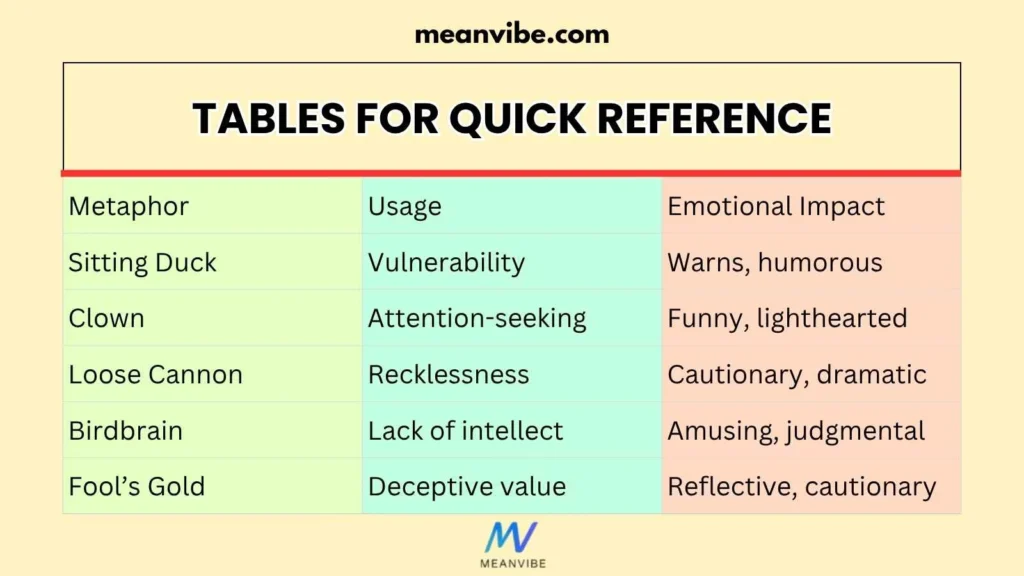
Here’s a table summarizing metaphors for a fool:
| Metaphor | Usage | Emotional Impact |
|---|---|---|
| Sitting Duck | Vulnerability | Warns, humorous |
| Clown | Attention-seeking | Funny, lighthearted |
| Loose Cannon | Recklessness | Cautionary, dramatic |
| Birdbrain | Lack of intellect | Amusing, judgmental |
| Fool’s Gold | Deceptive value | Reflective, cautionary |
How to Create Your Own Fool Metaphors 🖌️
Want to craft original metaphors? Follow this guide:
- Step 1: Identify the trait – naivety, recklessness, or ignorance
- Step 2: Connect it to a tangible object, animal, or scenario
- Step 3: Add humor or vivid imagery
- Step 4: Test for clarity – will readers immediately understand?
- Step 5: Refine and sprinkle into writing or speech
Metaphors vs Similes: What’s the Difference? 🔍
While metaphors assert one thing IS another, similes compare using “like” or “as”. Both work for describing fools:
- Metaphor: “He is a sitting duck.” 🦆
- Simile: “He’s like a sitting duck.” 🦆
Famous Quotes About Fools 💬
“Only a fool tests the depth of the water with both feet.” – African Proverb
“Fools rush in where angels fear to tread.” – Alexander Pope
“Better a witty fool than a foolish wit.” – Shakespeare
FAQs
1. What is a metaphor for a fool?
A metaphor for a fool is a figure of speech that describes someone who acts unwisely or naively using vivid imagery.
2. How can I use fool metaphors in writing?
Use them in dialogue, descriptions, or storytelling to convey folly humorously or vividly.
3. Can metaphors be humorous?
Absolutely! Many metaphors for fools, like “clown” or “sitting duck,” add humor while describing behavior.
4. Are metaphors better than literal descriptions?
Yes, they are more memorable, engaging, and create a stronger emotional connection with the reader.
Conclusion
Metaphors for a fool add color, emotion, and memorability to communication. From classic expressions to creative inventions, they help us convey folly with flair.
Use them wisely to entertain, warn, or illustrate points clearly. Remember, a well-chosen metaphor can make your words unforgettable!